
Your cart is empty.
You need to buy things!
You need to buy things!


"Dedo", as his mother called him, or "Modi", as all of Paris nicknamed him (a cruel pun on "maudit" - cursed), Amedeo Modigliani (1884-1920) is much more than a painter. He is an atmosphere. He is the carnal and spectral incarnation of that precise moment when the romantic 19th century crashed against the violent modernity of the 20th century. He lived only 35 years, but his life weighs the weight of a century of suffering and beauty.
Unlike Picasso, who destroyed to rebuild, Modigliani sought a lost harmony. His canvases do not scream; they whisper. His characters with swan necks and empty eyes do not look at us: they judge us, silently, from an inaccessible inner world. How did this son of a good Italian family become the prince of the vagabonds of Montparnasse? How did he transform the disease that gnawed at him into an artistic line of absolute purity? 🌑
In this article, we will not just skim over his life. We will dissect the man, the lover, the frustrated sculptor, and the genius painter.
 Self-portrait (1919): The artist paints himself emaciated, looking towards his own end.
The story begins under the sun of Livorno, in Tuscany 🇮🇹. Amedeo Clemente Modigliani was born on July 12, 1884. He was the fourth child of Flaminio Modigliani and Eugénie Garsin. His family came from the Sephardic Jewish bourgeoisie, intellectual and progressive. Family legend even has it that they descended from the philosopher Spinoza. But at Amedeo’s birth, fortune had turned: the father’s business had gone bankrupt. The bailiff seized the furniture while his mother was giving birth (an old Italian law forbidding the seizure of a bed of a woman in labor, the family piled valuables on the mother’s bed!).
His mother, Eugénie, was the central figure of his life. A woman of letters, she kept a diary where she prophetically noted in 1895: "Dedo had pleurisy... His character is not yet formed enough for me to say what I think of it. He behaves like a spoiled child, but he does not lack intelligence. We shall see what lies inside this chrysalis. Perhaps an artist?"
Death danced with him from the start. At 11, severe pleurisy. At 14, typhoid fever. It was during the hallucinatory deliriums of typhoid that he allegedly had the revelation of his vocation, speaking of the great masters of the Renaissance as if they were his friends. Then, around 16, the verdict fell: tuberculosis. At the time, it was a slow death sentence. This urgency to live explains his future frenzy: Modigliani knew he didn’t have time.
He abandoned classical studies for the Fine Arts. In Italy, he soaked up the Macchiaioli (Italian Impressionists) and ancient statuary. He visited Rome, Florence, Venice. He did not seek to break codes like the Futurists; he sought to reconnect with the grandeur of Botticelli, Tintoretto, and Romanesque sculpture.
At 21, with a little money from his mother, he took the train to Paris. It was the obligatory passage. He arrived with his gentlemanly manners, his corduroy suits, and his red scarf. He first settled in Montmartre, at the famous Bateau-Lavoir, neighbor to Picasso.
But Modigliani was not a Cubist. He did not get along with Picasso’s gang (whom he admired but whose success and robustness he envied). He migrated to the Left Bank: Montparnasse. It was there, at the Vavin crossroads, between Le Dôme and La Rotonde, that the legend was written. He became the "Prince of Vagabonds". Handsome, brooding, he seduced models, recited Dante on bistro tables, and paid for his drinks with drawings that owners sometimes threw in the trash (what a mistake!).
The romantic legend hides a sordid medical reality. Modigliani drank absinthe and took hashish not (only) out of vice, but to anesthetize the pain of his decomposing lungs. Alcohol allowed him to stand upright, to mask his coughing fits of blood. He lived in unsanitary studios, like at the Cité Falguière or La Ruche, where the cold kept him from sleeping.
Before posthumous glory, one man believed in him: Dr. Paul Alexandre. He was the first to buy his drawings and provide him with a place to work. Look at this portrait of Dr. Paul Alexandre: you see the elegance of the line, a certain aristocratic distance, long before the extreme stylization of the following years.
 Dr. Alexandre, the first unwavering supporter.
It is often forgotten, but Modigliani saw himself primarily as a sculptor. His meeting with Constantin Brancusi in 1909 was seismic. Brancusi, the Romanian hermit, taught him "direct carving". No more modeling clay, one must attack the stone, fight with the material.
Modigliani stole railroad ties or construction stones at night (legend even says he stole some from the Barbès metro construction site). He carved hieratic "Heads", a mix of Greek Cycladic art, Khmer art, and African masks (which he discovered at the Trocadéro Museum). These heads are totems, silent idols.
But this passion killed him. Limestone dust attacked his already fragile lungs. In 1914, exhausted, he had to give up. It was heartbreaking. He returned to painting, but he imported the lesson of stone into it: his painted portraits would henceforth be two-dimensional sculptures. The nose becomes a ridge, the neck a column.
Between 1915 and 1920, Modigliani reached his maturity. He produced masterpiece after masterpiece. Let’s analyze his unique technique.
He did not seek classical psychological realism. He sought the archetype. Take the painting Alice or The Little Peasant. The face is a perfect oval, the nose is an arrow, the mouth a small fleshy incision (Modigliani’s famous "pouty mouth"). Necks are stretched to give nobility, even to a maid or a peasant.
His palette is warm, Mediterranean. He abundantly uses ochres, siennas, brick reds, deep oranges, which contrast with often gray-blue or green backgrounds. It is the warmth of Tuscany transported to the Parisian grayness.
This is what disturbs the most. Why these pupil-less eyes? Sometimes sky blue, sometimes black, sometimes mismatched (one painted, the other empty). Modigliani explained: "When I know your soul, I will paint your eyes." Empty eyes mark introspection. The model does not look at the viewer; they look within themselves. It is a refusal of anecdote to touch the universal.
Observe the portrait of Lunia Czechowska. She posed for him dozens of times. Her face is a modern Byzantine icon.
 The Little Peasant: The nobility of the humble.
It was Léopold Zborowski, a Polish poet turned art dealer (who ruined himself supporting Modi), who suggested he paint nudes. He installed Modigliani in his apartment, provided him with models, canvases, coal, and wine, and paid him 15 to 20 francs a day.
The result is a series of breathtaking nudes, painted with incredible speed and sureness of hand. Unlike Renoir’s (milky) or Picasso’s (deconstructed) nudes, Modigliani’s are of immediate carnal presence. The skin is golden, warm. The bodies occupy the entire space of the canvas, often cut off at the knees to bring the viewer closer.
In December 1917, Zborowski organized an exhibition at the Berthe Weill gallery. As soon as the opening began, the police arrived. Commissioner Rousselot was shocked by the painting in the window. The exchange remained famous:
— Take down this filth!
— But what is so obscene about these nudes? asked Berthe Weill.
— These nudes have hair!
That was Modigliani’s crime: having painted the reality of the female body, pubic hair included, instead of a smooth idealization. The expo closed that same evening. Modigliani sold nothing.
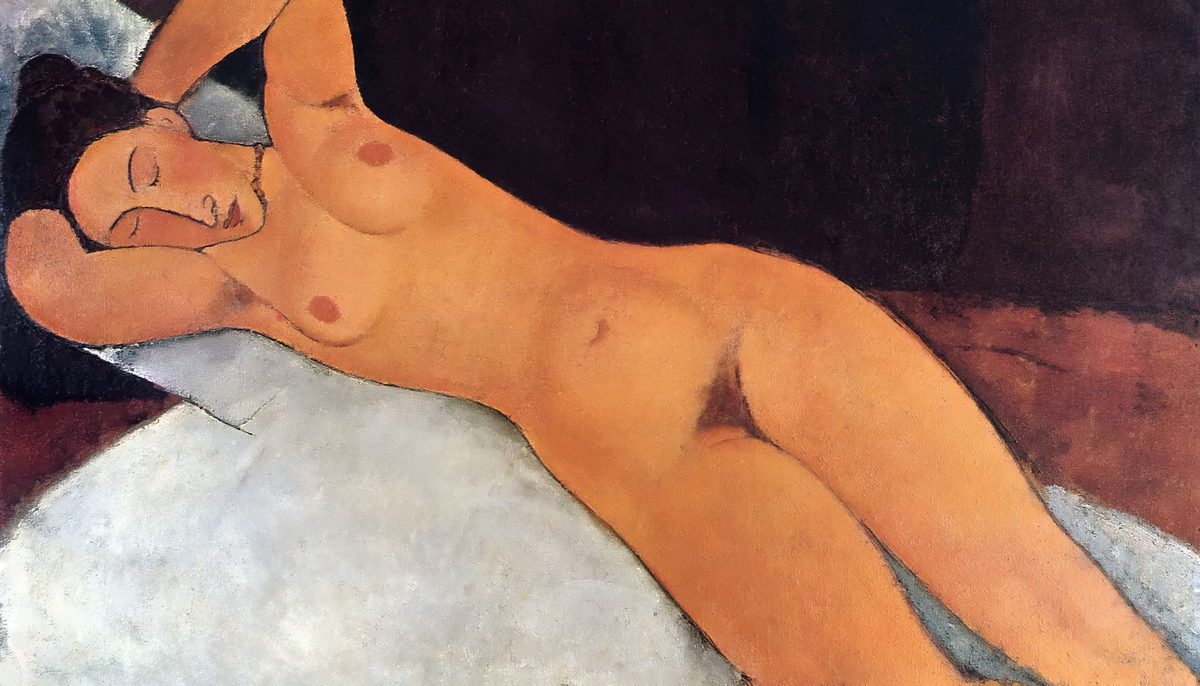 An icon of modern sensuality, censored in 1917.
In 1917, he met absolute love: Jeanne Hébuterne. She was 19, he was 33. She was sweet, silent, with a long braid and a porcelain complexion that earned her the nickname "Coconut". She was a student at Arts Déco. Despite the fury of her Catholic family (who rejected this penniless Jew), she moved in with him.
In 1918, Zborowski sent the couple to Nice and Cagnes-sur-Mer to try to heal Modigliani’s lungs far from the Parisian winter. There, under the light of the French Riviera, Modigliani’s palette brightened. He painted portraits of children, landscapes (very rare for him), and especially Jeanne, pregnant. On November 29, 1918, their daughter, Jeanne (called Giovanna), was born in Nice.
It was a period of respite, but worry remained. Modigliani painted frantically, as if he sensed the end. His portraits of Jeanne, like Jeanne in a Large Hat, are imbued with infinite sweetness and resigned sadness.
Back in Paris in 1919, Modigliani’s condition worsened. He coughed up blood. He refused to see a doctor. In January 1920, his neighbor downstairs, the painter Ortiz de Zarate, found him delirious in his icy bed, holding the hand of Jeanne, nine months pregnant. He was transported to the Charité hospital.
He died on January 24, 1920, at 8:50 PM, of tubercular meningitis. His last words were reportedly for Italy. Jeanne was taken back to her parents, mute. Two days later, at 4 AM, she threw herself from the 5th-floor window. She killed with her the child she was carrying. Modigliani was buried like a prince by his friends; Jeanne was buried furtively by her family at the Bagneux cemetery. It would take 10 years for the Hébuterne family to agree to transfer her body to Père-Lachaise, alongside her love.
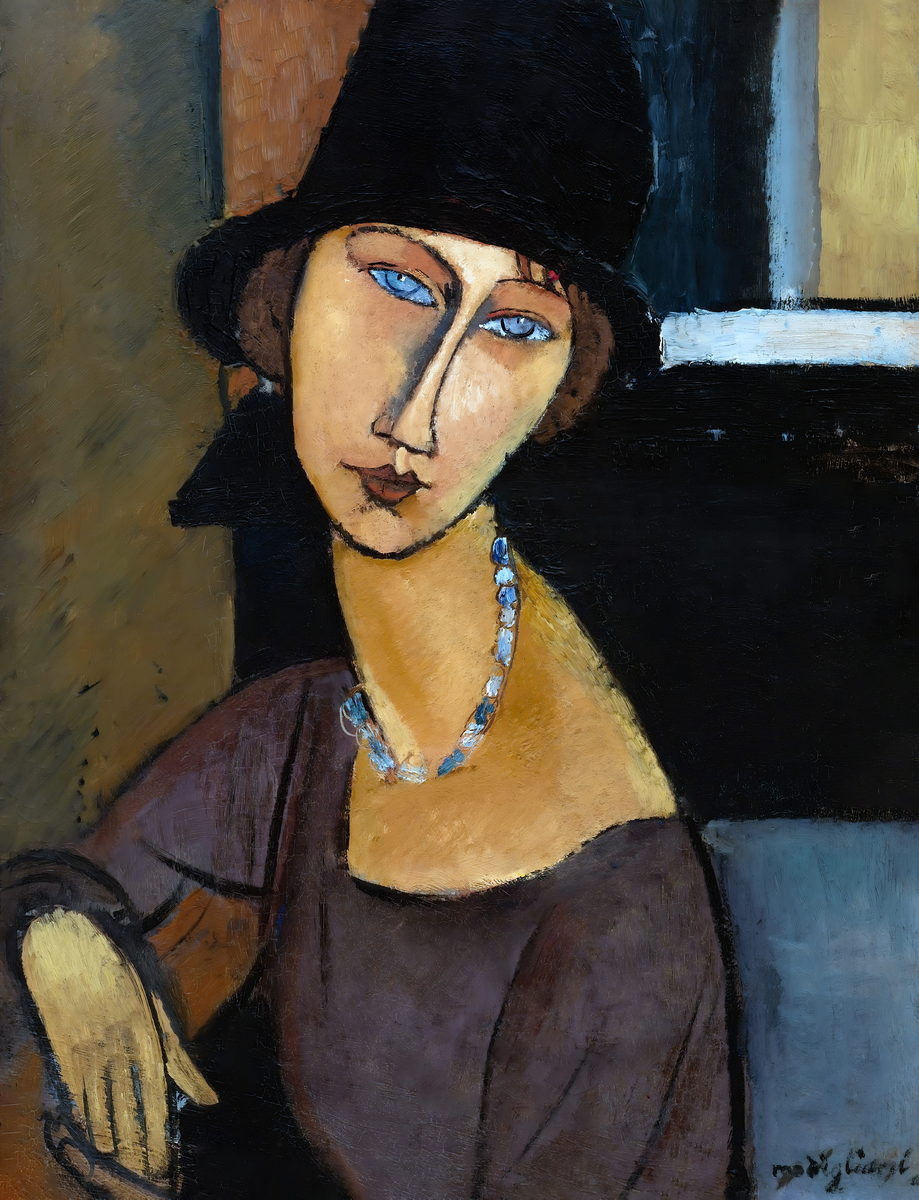 Jeanne, painted with infinite tenderness a few months before the tragedy.
Today, Modigliani is one of the three most expensive artists in the world. Why?
In 2015, Chinese billionaire Liu Yiqian bought the Reclining Nude for over 170 million dollars. A dazzling revenge for the one who exchanged his drawings for a hot meal at La Rotonde.
Amedeo Modigliani never compromised. He lived for beauty, by beauty, and he died of it. He leaves us a gallery of faces that are mirrors of our own solitudes. Looking at a Modigliani is accepting to slow down, to be silent, and to dive into the mystery of being. He painted souls, and souls never die. ✨
Save 10 % for your FIRST PURCHASE Save 15 % on orders over 350 € excl. tax and 20 % on orders over 650 € excl. tax |


