
Your cart is empty.
You need to buy things!
You need to buy things!


Choosing artwork to enhance your home decor is an exciting journey, but a crucial question quickly arises: what size painting should you choose to maintain the visual harmony of a room? An artwork, whether a magnificent hand-painted oil painting on canvas or a master painting reproduction, does not exist in isolation. It is in constant dialogue with your room’s volume, ceiling height, furniture width, and ambient lighting.
A painting that is too small will appear lost and isolated on a large wall surface, creating an awkward “postage stamp effect.” Conversely, an overly imposing canvas can overwhelm wall decor, visually shrink the space, and disrupt the overall balance of your interior design. Finding the perfect size relies on proportion rules proven by interior designers, gallery curators, and decorators.
In this comprehensive and practical guide, we will review all the concrete techniques and tips to determine with confidence the right dimensions for your decoration project: from golden proportion rules to choosing the format (portrait, landscape, square, triptych, panoramic), including a detailed room-by-room analysis (living room, bedroom, dining room, office, entryway, hallway, staircase) and piece-by-piece furniture guide (sofa, bed, sideboard, console, fireplace). You will also discover how to simulate your hanging without drilling a single hole and how to avoid the most common alignment mistakes. 🎨✨
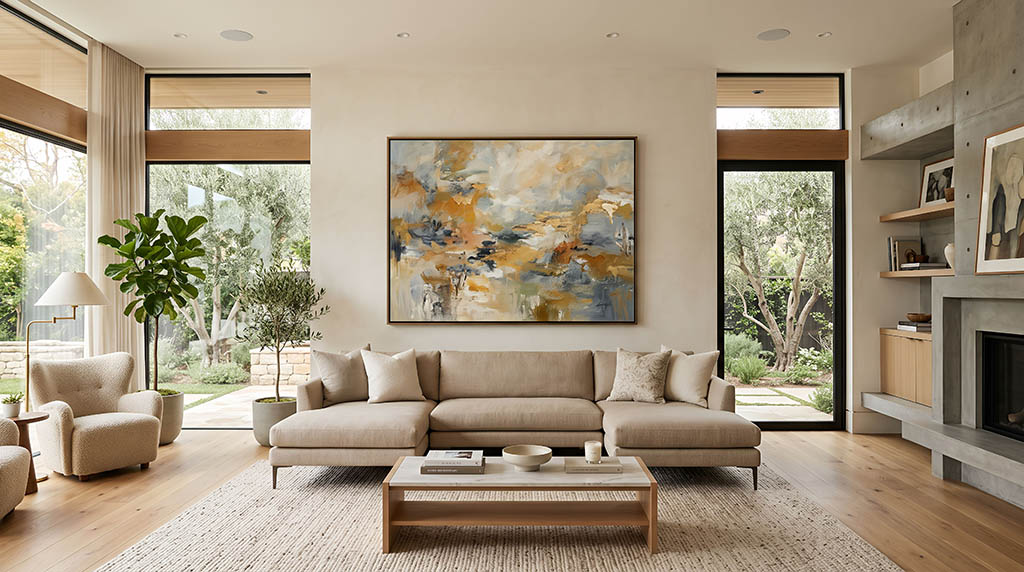 Balanced Living Room Illustration: Minimalist and Comfortable Living Space.
Before falling in love with a canvas or art reproduction, it is essential to master the fundamental principles of framing and visual scale. The human eye spontaneously perceives relationships of mass and symmetry. When these proportions are balanced, the space provides an immediate feeling of calm, comfort, and elegance.
In wall decor, the empty space around a painting is just as important as the artwork itself. In design, this is called breathing room. If the piece occupies the entire width of a wall or nearly touches the ceiling, the room immediately feels narrower and cluttered. Conversely, if the empty space surrounding the frame is disproportionate to the size of the painting, the artwork loses its visual impact and appears to float without anchor.
This is the universal rule adopted by interior design professionals: the ideal width of a painting (or gallery wall composition) should represent between 60% and 75% of the width of the furniture piece directly below it.
For example, if your living room sofa is 200 cm wide:
By following this size range, your painting naturally aligns with the visual extension of the furniture without exceeding its boundaries, creating a perfectly harmonious aesthetic anchor.
In addition to width, the distance separating the painting from surrounding obstacles must meet precise criteria:
While mathematical rigor guarantees flawless results, interior design also allows breaking codes for bold stylistic effects:
Every room in your home has its own purpose, traffic flow, and dominant furniture. Here is a detailed breakdown to select the ideal artwork dimensions for each space.
The living room is the main gathering space of the home, the primary place for entertaining and relaxation. This is where you typically find the largest open wall in the house.
The bedroom is a sanctuary of intimacy and rest. Wall artwork should convey serenity and peace.
In the dining room, attention focuses on the dining table and sideboard.
The home office requires an inspiring environment without creating excessive visual distraction during work hours.
The entryway sets the tone as soon as you step across the threshold. It is often a narrow space, yet one with high visual impact.
A transitional area par excellence, the hallway offers an up-close and dynamic view of wall artworks.
A staircase wall features a unique architectural diagonal that should be followed harmoniously.
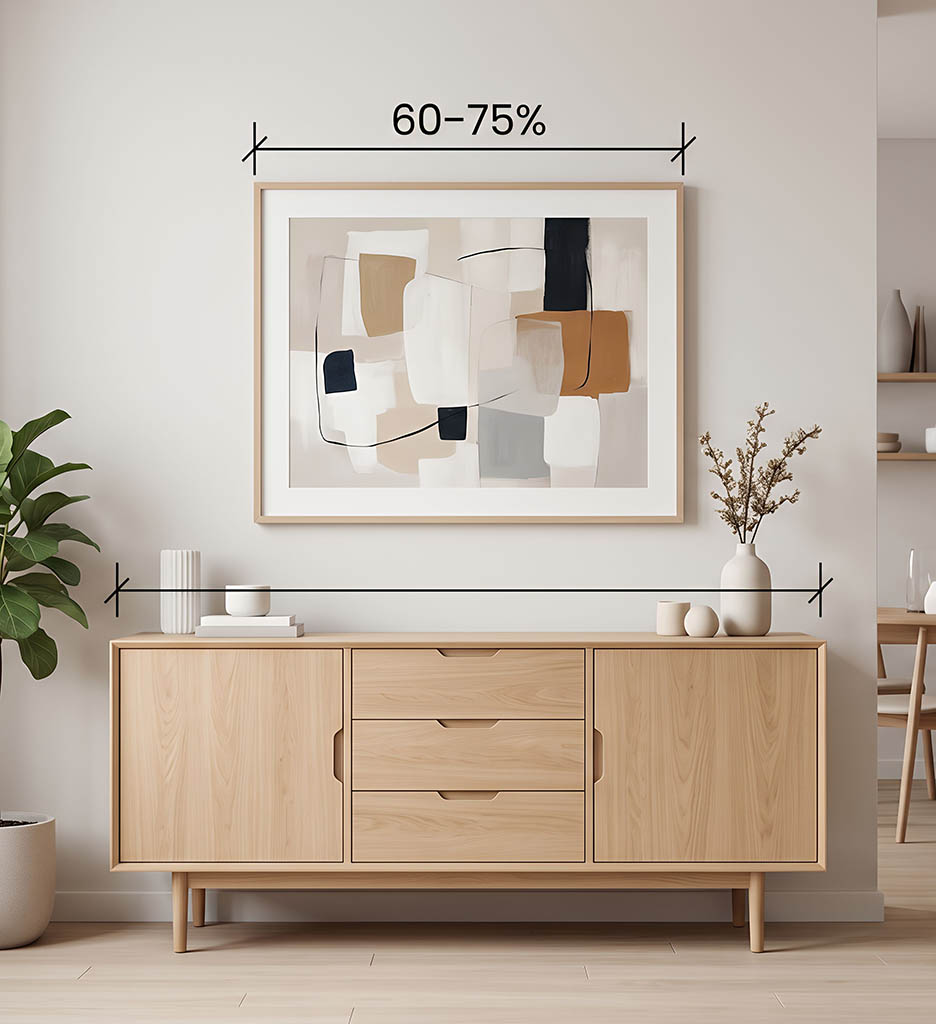 Wall art proportion for sideboard.
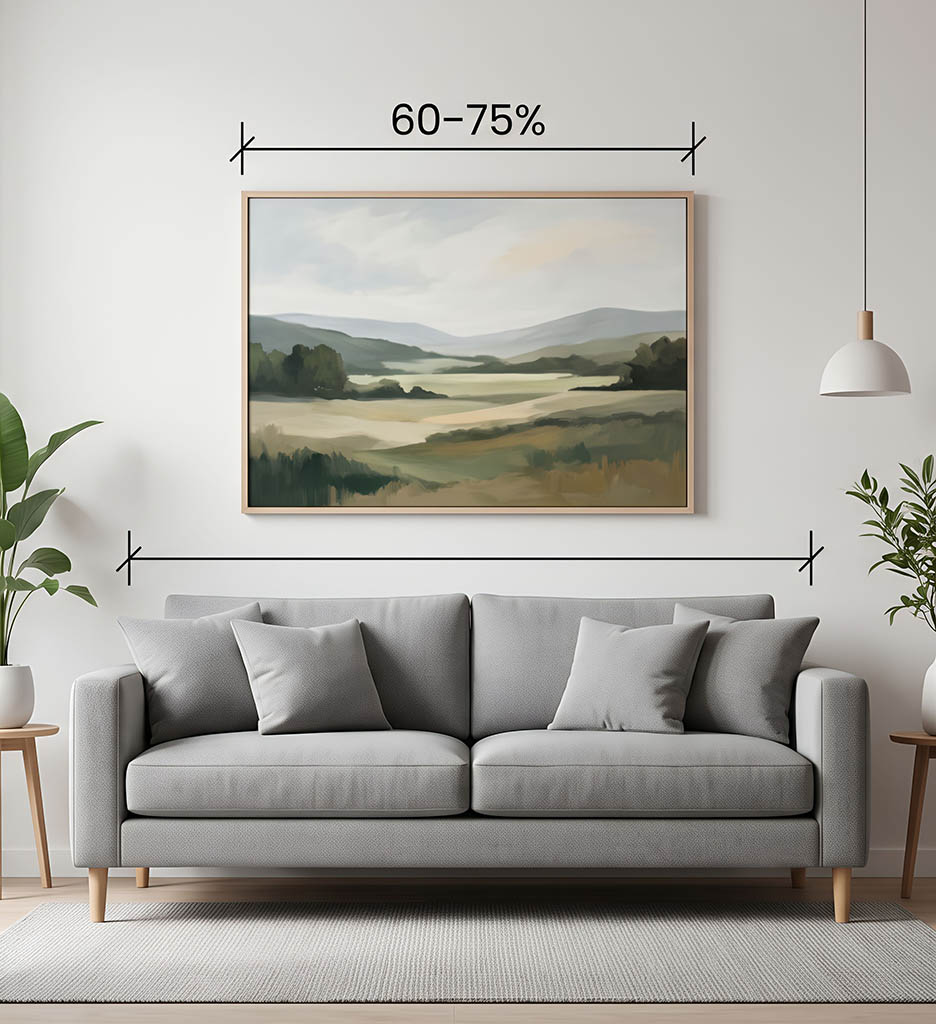 Wall art proportion for sofa.
Furniture serves as a visual anchor for artwork. If a canvas is not proportioned to the furniture piece below it, the overall arrangement feels unbalanced and awkward. Here are precise recommendations for each type of furniture.
| Furniture Type | Typical Furniture Width | Ideal Painting Width | Recommended Clearance Space |
|---|---|---|---|
| 3-Seater Sofa | 200 cm - 220 cm | 120 cm - 160 cm | 20 cm - 25 cm |
| Queen Size Bed (160 cm) | 160 cm | 100 cm - 120 cm | 20 cm - 30 cm above headboard |
| Credenza / Sideboard | 180 cm - 200 cm | 110 cm - 140 cm | 15 cm - 25 cm |
| Entryway Console | 100 cm - 120 cm | 60 cm - 80 cm (Portrait) | 15 cm - 20 cm |
| Fireplace Mantle | 120 cm - 150 cm | 80 cm - 100 cm | 10 cm - 15 cm above mantle |
| Executive Desk | 130 cm - 150 cm | 80 cm - 100 cm | 20 cm |
Furniture width: 200 cm - 220 cm
Ideal width: 120 cm - 160 cm
Recommended clearance: 20 cm - 25 cm
Furniture width: 160 cm
Ideal width: 100 cm - 120 cm
Recommended clearance: 20 cm - 30 cm above headboard
Furniture width: 180 cm - 200 cm
Ideal width: 110 cm - 140 cm
Recommended clearance: 15 cm - 25 cm
Furniture width: 100 cm - 120 cm
Ideal width: 60 cm - 80 cm (Portrait)
Recommended clearance: 15 cm - 20 cm
Furniture width: 120 cm - 150 cm
Ideal width: 80 cm - 100 cm
Recommended clearance: 10 cm - 15 cm above mantle
Furniture width: 130 cm - 150 cm
Ideal width: 80 cm - 100 cm
Recommended clearance: 20 cm
The sofa is typically the largest furniture piece in the living room. To dress the wall elegantly, choose a canvas or set of artworks whose total width covers between two-thirds and three-quarters of the sofa. Leave a margin of about 20 to 25 cm above the back cushions to avoid any risk of bumping your head when leaning back.
Above the headboard, the canvas should create a calming focal point. For a 160 cm wide bed, a horizontal painting measuring 100x70 cm or 120x80 cm centered above the frame offers perfect geometry. Keep 20 to 30 cm between the top of the headboard and the bottom of the frame.
Low sideboards and credenzas often measure between 180 cm and 220 cm in length. A large horizontal painting of 120x80 cm or a triptych made of three 40x80 cm panels spaced 5 cm apart creates a majestic visual backdrop. Mind decorative items placed on the sideboard (lamps, vases): they should slightly overlap the bottom of the painting without masking the main artwork subject.
As console tables are generally narrower (80 cm to 120 cm), vertical portrait format is the most harmonious choice. A 60x90 cm painting centered 15 cm above the tabletop elevates the gaze and elongates the room.
The fireplace mantle is a classic architectural focal point. The painting width should never exceed the mantle shelf width (aim for about 70 to 80% of this width). Hang the painting 10 to 15 cm above the shelf, or rest it directly on top if the fireplace is non-operational.
For a 140 cm wide desk, a canvas spanning 80 cm to 100 cm in width ideally balances the workspace area. Ensure the height does not interfere with desk lamps or wall shelving.
Choosing artwork size goes hand in hand with selecting the right geometric canvas format. Each format possesses its own visual dynamic and preferred spaces.
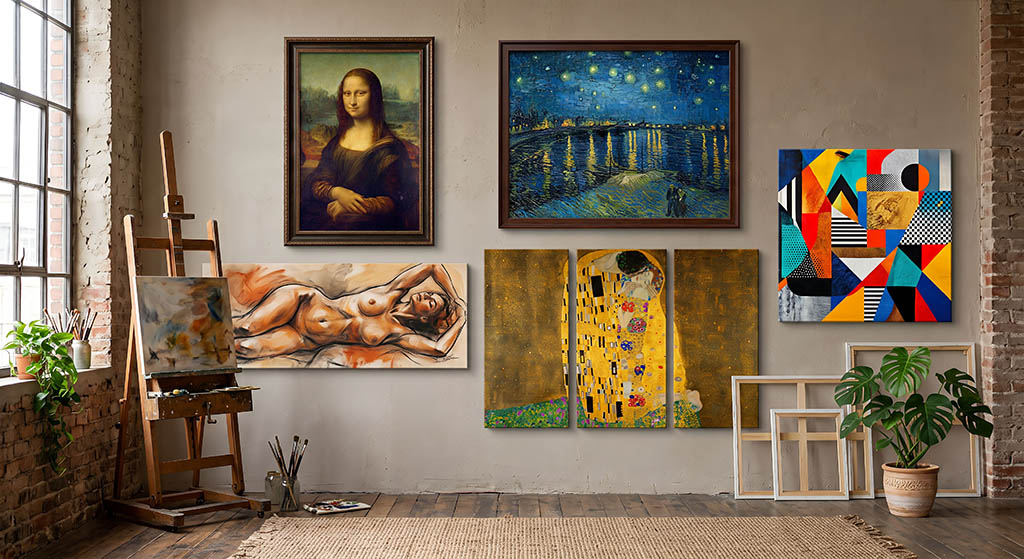 Classicism, Expressionism, and Geometry: An Eclectic Art Wall
To avoid disappointment and unnecessary holes in plasterwork, careful preparation is required. Here is the foolproof method recommended by professional art installers.
Gather the following equipment before purchasing your painting:
Prepare a tape measure (preferably a rigid 3-to-5-meter measuring tape), painter’s masking tape (or kraft paper cut to canvas dimensions), a bubble level, a pencil, and a notepad.
This is the ultimate interior decorator secret! Don’t rely solely on imagination:
Cut out a piece of kraft paper or outline the exact dimensions of your desired painting on the wall using painter’s masking tape (which won’t damage wall paint). Leave this template on the wall for 24 to 48 hours. Step back, observe it at different times of day, from the entrance doorway and while seated on your sofa. You will instantly know if the chosen dimensions are too large, too small, or perfect!
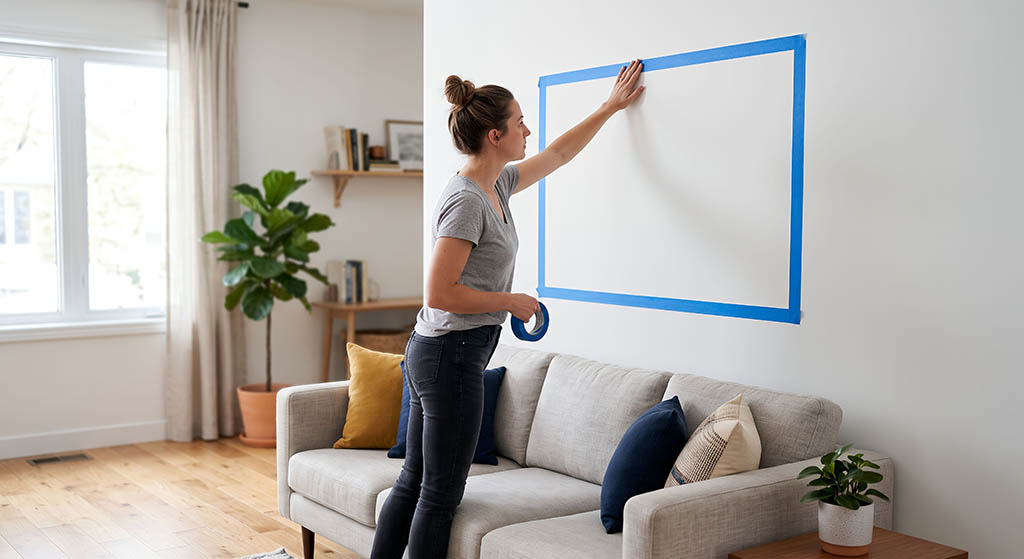 DIY Project in Progress: Masking Tape Method
Identifying the most common hanging mistakes will prevent you from undermining the visual ambiance of your home.
Why it hurts: The artwork looks lost, neglected, and undersized. The wall looks empty.
Solution: Pair your painting with other small frames to build a gallery wall, or relocate the artwork to a narrower wall section (such as between doors or in an entryway).
Why it hurts: The painting crushes the furniture underneath and visually shrinks room volume.
Solution: Choose a canvas with lighter margins or select a triptych whose spacing between panels softens overall mass.
Why it hurts: Hanging a painting too high (often near the ceiling) disconnects it from furniture and forces uncomfortable head-tilting.
Solution: Lower the artwork center to standard eye level: 145 cm to 155 cm from the floor.
Why it hurts: Frames hung at chaotic heights without a guiding axis create visual clutter.
Solution: Establish a center horizon line or bottom edge alignment for all frames.
Why it hurts: Placed too close, artworks crowd each other; too far apart, visual cohesion breaks.
Solution: Maintain a strict, uniform spacing between 5 cm and 8 cm between frames.
Why it hurts: Placing a narrow vertical portrait painting in the center of an elongated horizontal wall creates visual conflict.
Solution: Align artwork orientation with the general shape of available wall space.
Beyond mathematical dimensions alone, successfully integrating artwork relies on subtle color harmonies, materials, and lighting.
Each interior design style interacts differently with wall art:
To integrate a canvas naturally into your living room or bedroom, echo 1 or 2 dominant paint colors in room textiles (cushions, rugs, curtains, or an accent chair). This subtle color repeating creates immediate visual cohesion.
For an original oil painting on stretched canvas, a floating frame (caisse américaine) is the premium choice. By leaving a subtle gap of a few millimeters around the canvas edge, it creates an impression that the artwork floats inside the frame without obscuring brushwork.
Lighting highlights the texture and rich pigments of hand-painted oil art. Avoid direct sunlight on oil canvases to preserve vibrant colors long-term. For night viewing, install a warm LED picture light (2700K - 3000K) positioned directly above the frame.
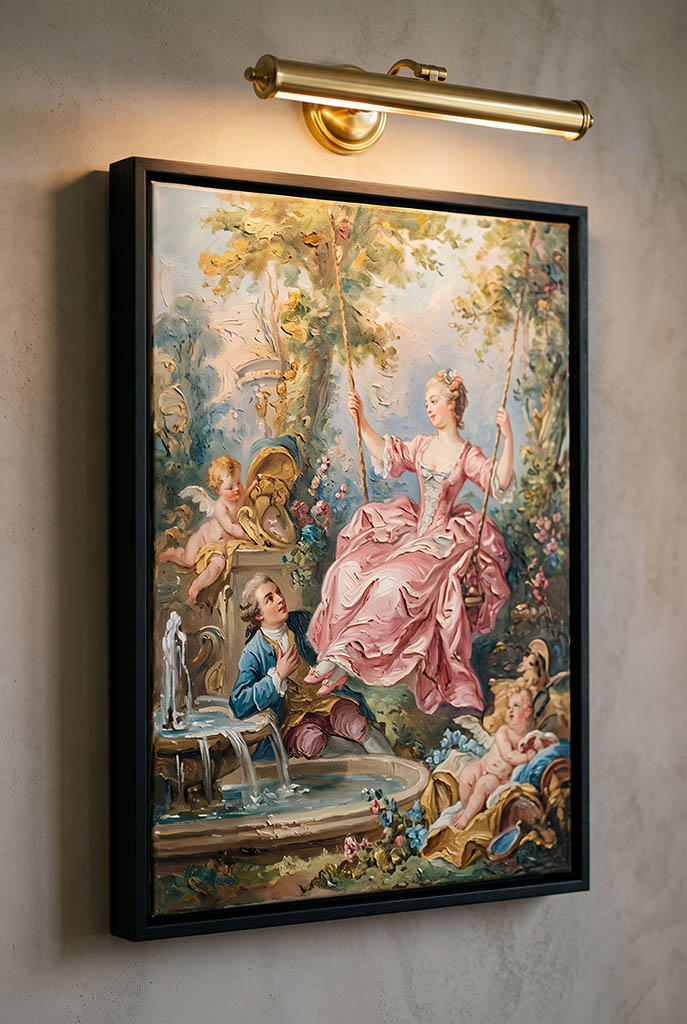 The Swing.
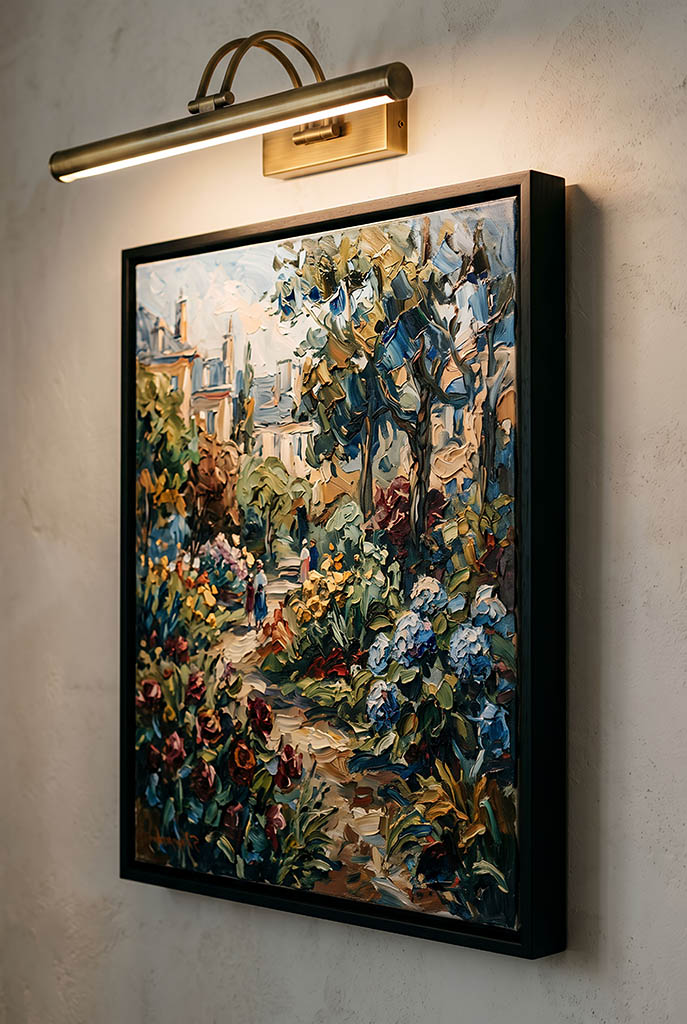 Hydrangea Alley.
Q1: What size painting above a 200 cm sofa?
For a 200 cm wide sofa, apply the 60% to 75% rule. The ideal total width for your painting (or group) is between 120 cm and 150 cm. A horizontal 120x80 cm canvas or a 3-panel triptych of 40x80 cm panels provides the most balanced composition.
Q2: What exact height should a painting be hung at?
International art gallery standards place the center of the canvas at 145-155 cm from the floor. Above furniture (sofa, sideboard, bed), allow a clear gap of 15 to 25 cm between top of furniture and bottom of frame.
Q3: Can you mix different frame sizes and styles on one wall?
Absolutely! That is the essence of a gallery wall. To ensure visual harmony, maintain a unifying element: either a shared color palette, consistent frame finishes, or a uniform spacing (5 to 8 cm) between frames.
Q4: How to decorate a large blank wall without overcrowding it?
You have two main options: choose a single large XXL wall painting (e.g., 120x160 cm or 140x200 cm) to serve as a dramatic centerpiece, or select a dynamic diptych or triptych composition that introduces airy elegance.
Q5: How many paintings can be hung on the same living room wall?
It depends on the desired effect. For a refined minimalist look, a single large painting or a pair (diptych) is plenty. For an eclectic or collector vibe, you can group 5 to 12 paintings while maintaining breathing room around the cluster.
Q6: Should I choose a horizontal or vertical painting for a bedroom?
Above the bed, a horizontal painting (landscape or panoramic format) is vastly preferred because it echoes the bed’s width. On a narrow side wall, a vertical painting will fit perfectly.
Q7: Can you hang a painting on a wall without furniture underneath?
Yes! In this case, the artwork must have enough scale to stand on its own. Choose a large portrait format or an imposing square canvas, positioning its visual center strictly at 150 cm from the floor.
Q8: What size painting should I choose for a small entryway?
To avoid cluttering a small entryway visually, opt for a compact vertical format of 50x70 cm or 60x80 cm, ideally placed above a slender console table.
Q9: How much spacing should be left between triptych panels?
The recommended gap between panels of a triptych or diptych is 3 cm to 5 cm. Spacing them further apart disrupts the illusion of a unified artwork.
Q10: How to create a successful gallery wall without mistakes?
Before driving any nails, lay all your frames flat on the floor on a blanket. Test different arrangements until you achieve perfect balance, then cut kraft paper templates to tape onto the wall before final drilling.
Q11: How to integrate a hand-painted oil reproduction into modern decor?
A hand-painted oil painting reproduction brings rich texture and prestige to contemporary interiors. To keep it fresh and modern, pair classic artwork with an ultra-sleek frame (such as a thin floating frame) and clean-lined modern furniture.
Q12: Do hand-painted oil canvases mounted on wooden stretchers require framing?
No, framing is not mandatory. If the stretched canvas edges are cleanly painted (gallery wrap finish), the painting can be hung unframed for a sleek contemporary style. However, framing remains highly recommended for a polished finish and to protect canvas edges.
Choosing the ideal painting size is not a matter of luck, but the result of a thoughtful balance between mathematical proportions and artistic intuition. By applying the golden rule of 60% to 75% of your furniture width, respecting eye-level hanging height (150 cm from the floor), and testing dimensions with kraft paper templates, you have all the keys to successful wall decor.
Remember that a painting is far more than a decorative accessory: it is the heart of your room, a focal point that draws the eye and evokes emotion. Whether choosing a grand abstract canvas for your living room or a breathtaking hand-painted oil reproduction for your bedroom, taking the time to measure your walls guarantees a spectacular presentation for years to come. 🖼️❤️
Save 10 % for your FIRST PURCHASE Save 15 % on orders over 350 € excl. tax and 20 % on orders over 650 € excl. tax |


